

Countdown to a Specific Time of Day: 8am, 2:30, 3pm, 4:45, 5pm, 6pm and 11pm
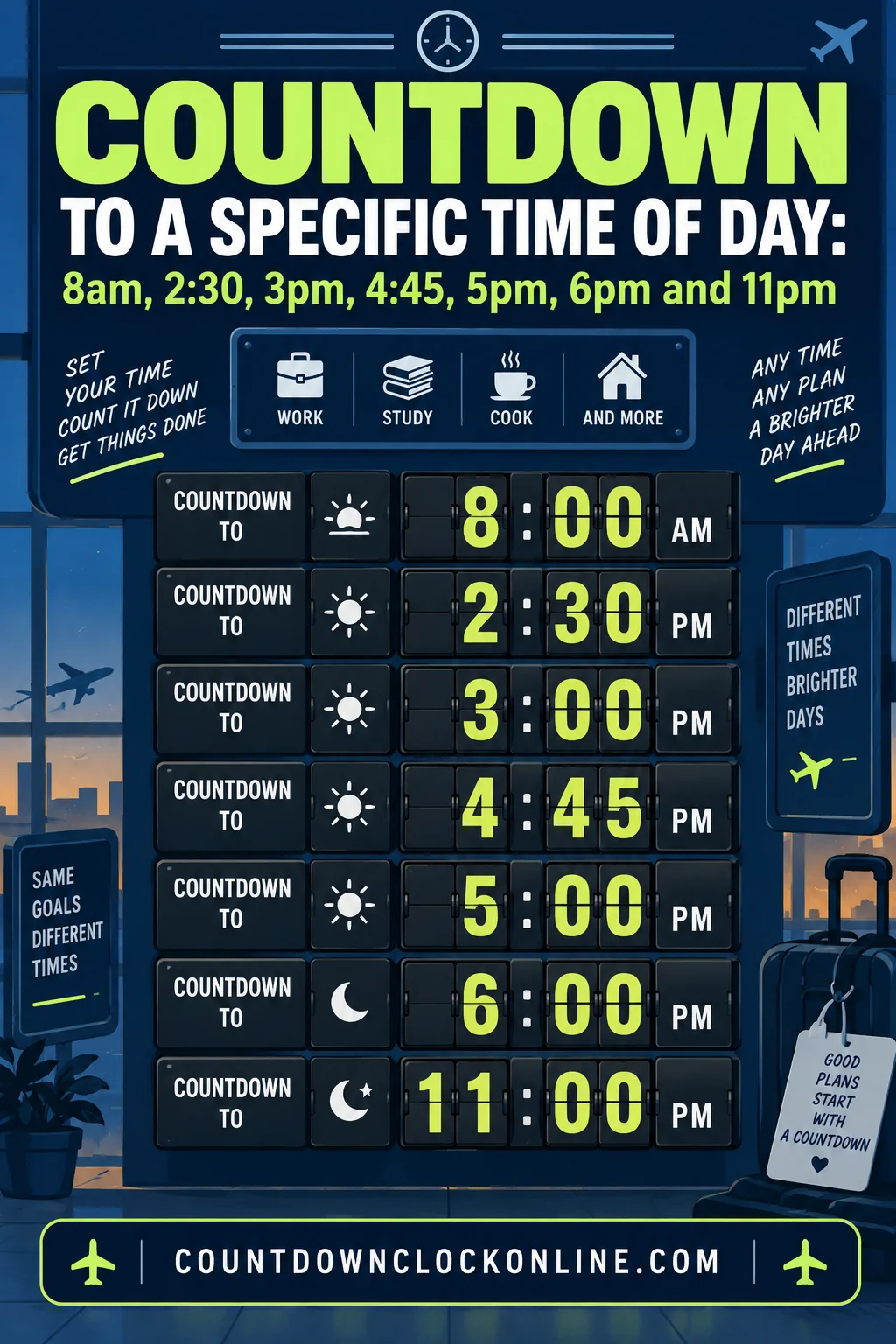
A countdown to a specific time of day is anchored to the clock on the wall, not to the moment you press start — which is why the same timer can read six hours for one person and eleven minutes for another. Set a 20-minute timer and it always runs 20 minutes. Set a countdown to 3pm and it runs however much of the day is left between now and 15:00 where you are standing.
That difference is the whole reason these countdowns are useful. You are not measuring a duration. You are measuring your position in the day relative to a fixed event: a bell, a shift change, a market close, a pickup line, a dose, a deadline. This guide covers the specific target times people actually count toward, what each one is usually about, and the three things that break clock-time countdowns — time zones, daylight saving transitions, and a target that has already gone by.
What a Clock-Time Countdown Actually Measures
A countdown to a clock time takes your device's current local time, finds the next occurrence of the target time, and subtracts. Three consequences follow, and all three surprise people.
It shrinks as the day goes on. Open the same page at 9am and at 2:50pm and it will show wildly different numbers. Nothing is broken.
It is local by default. The countdown reads the clock on the device it is running on. If you and a colleague in another region open the same countdown, you will see different numbers unless the countdown has been explicitly pinned to one zone.
It rolls over. If the target has already passed today, a well-behaved countdown targets tomorrow rather than showing a negative number or zero. That is usually the right answer, and occasionally it is not — more on that below.
Here is what the common target times are typically about:
| Target time | Who is usually watching it | What it marks |
|---|---|---|
| 8am | Parents, early-shift workers, patients | Doors open, shift starts, morning dose |
| 2:30 | Parents, teachers, students | The pickup line and the last bell |
| 3pm | Traders, warehouse staff, office workers | Final trading hour, shipping cutoff, shift change |
| 4:45 | Anyone with a hard 5pm handoff | The fifteen-minute warning |
| 5pm | Office workers, filers, support teams | End of the business day and its deadlines |
| 6pm | Families, gym-goers, pharmacy customers | Dinner, class start, closing time |
| 11pm | Night-shift staff, patients, bargain hunters | Late dose, shift start, offers expiring |
Countdown to 8am: The Start of Everything
8am is the hour the day officially opens, and a countdown to 8am is nearly always about not being late for something that starts precisely.
The most common use is medication timing. Plenty of prescriptions want a dose taken with breakfast at a consistent hour, and consistency matters more than the specific hour — a visible countdown on a kitchen tablet or a phone propped on the counter converts "sometime in the morning" into a number that reaches zero at the same moment every day.
The second use is anything that opens at eight. Clinics, DMV offices, ticket sales, appointment booking lines and registration windows all tend to open on the hour, and the practical goal is to be ready thirty seconds early rather than to notice at 8:04 that the slots are gone. A countdown to 8am running in a browser tab beside the booking page is the difference between getting a slot and getting a waitlist.
The third is the school run in reverse: counting toward the drop-off bell rather than toward pickup. A countdown displayed where children can see it moves a household better than an adult repeating "we need to leave."
Countdown to 2:30: The Pickup Line
2:30 is the school hour, and a countdown to 2:30 is overwhelmingly about pickup — either being in the line before it forms, or knowing exactly how much working time is left before you have to be in the car.
That second framing is the one that changes behavior. Parents working from home lose the afternoon not to pickup itself but to the low hum of not knowing whether there is enough time to start something. A visible countdown answers it. Two hours and ten minutes is enough to start a real task. Twenty-two minutes is not, and knowing that is what stops you from beginning something you will have to abandon.
Teachers use the same target from the other side. A countdown to 2:30 on a classroom display is a pacing instrument — it tells a room how much of a period remains without anyone having to ask.
People almost always type this one without punctuation. A search for countdown to 2 30 is the same request as a countdown to 2:30, because phone keyboards make colons awkward and nobody bothers.
Countdown to 3pm: The Afternoon Hinge
3pm carries more distinct meanings than any other hour on the clock, which is why it draws the most searches.
For anyone watching markets, 3pm Eastern begins the final hour of the US trading session — the stretch where volume rises and positions get closed before the bell. Traders who want to be at their desk for that hour, rather than noticing it started twenty minutes ago, run a countdown to 3pm and treat zero as a warning rather than an event.
For warehouse, fulfillment and shipping work, 3pm is a very common carrier cutoff. Packages handed over before it go out today; packages after it go out tomorrow. A countdown on a shared screen turns that from a policy people remember into a deadline people can see.
For a large share of shift work, 3pm is the change of shift — the end of a first shift that started at seven and the start of a second that runs to eleven. And in offices, 3pm is the informal last call for anything that needs a colleague's response before they leave.
The useful move with 3pm is to count to 2:45 instead if the thing at 3pm requires you to already be somewhere. A countdown that hits zero at the moment you are supposed to be in position is fifteen minutes too late.
Countdown to 4:45: The Fifteen-Minute Warning
4:45 is not a destination, it is a warning line, and that is exactly why people set it.
If your day ends at five with a handoff, a status update, a shift report or a call, then 4:45 is the moment you have to stop starting things. A countdown to 4:45 buys back the fifteen minutes that otherwise disappear into finishing one more item and then rushing the handoff.
Nurses and shift-based staff use this heavily. Handoff quality drops sharply when the outgoing person is still working at the moment the incoming person arrives, and a visible quarter-to marker on a unit screen is a cheap fix for that.
The same logic applies to school dismissal at the end of after-school programs, to closing procedures in retail, and to any meeting with a hard stop. As with 2:30, people type it as countdown to 4 45 without the colon far more often than not, and a countdown page that only accepts punctuated times is failing half its visitors.
Countdown to 5pm: The End of the Business Day
5pm is the most deadline-loaded hour on the clock. Filing windows close at 5pm. Submission portals close at 5pm. Support queues stop taking new tickets at 5pm. Offices empty at 5pm.
Searches here split into two shapes. A countdown to 5pm today is someone with a same-day deadline who needs the number right now, and who wants the countdown to refer to today specifically rather than roll into tomorrow if they are already past it. A countdown to 5 00 pm is the same request typed with the minutes spelled out, usually by someone who has been burned before by a page interpreting "5" as 5am.
If your 5pm is a genuine deadline with consequences, set two countdowns: one to 4:30 and one to 5:00. The first is when you stop editing and start submitting. Portals get slow at the end of the day, and uploads fail at the worst possible moment.
Countdown to 6pm: Dinner, Class and Closing Time
6pm is the household hour. A countdown to 6pm is usually about a family converging on the same place at the same time.
Dinner is the obvious one, and a countdown does something a shouted announcement does not: it gives everyone in the house the same information at the same time, so the fifteen-minute warning is a fact on a screen rather than a negotiation. Households with children old enough to read a clock find this reduces the number of times anyone has to say "how long?"
The second use is class start times. Evening gym classes, adult courses, rehearsals and youth sports overwhelmingly start at six, and the useful countdown is not to six but to the moment you have to leave — which is six minus your travel time. Set the target accordingly.
The third is closing time. Pharmacies, service counters, post offices and many clinics close at six, and a countdown to 6pm running while you decide whether to make the trip is a straightforward answer to "do I have time?"
Countdown to 11pm: The Late Marker
11pm is the boundary between evening and night, and the reasons for watching it are more specific than any other hour on this list.
Medication is the biggest one. Evening doses are frequently scheduled for eleven, and evening is exactly when a routine is most likely to slip — you are tired, the day has been long, and the difference between 11pm and midnight is easy to lose. A visible countdown to 11 pm is a far better prompt than an intention.
Night shift is the second. Eleven is a standard start for overnight work, and the countdown people actually want is to their departure time, not their start time, for the same reason as the 6pm class.
The third is expiring offers. Sales, auction endings, application windows and registration deadlines are often set to end at 11pm or 11:59pm in some specific zone, and this is where clock-time countdowns cause the most avoidable losses. Confirm the zone before you trust the number.
Time Zones: The One Thing That Breaks These
A clock-time countdown is only meaningful if you know whose clock it is reading.
By default, a countdown to 3pm run in a browser reads your device's local time and counts to 3pm where you are. That is right for personal use and wrong for almost every shared use. If a deadline is 5pm Eastern and you are two zones west, a countdown reading your local clock will tell you that you have three more hours than you actually do.
Three rules cover it:
- For anything personal — dinner, a dose, a pickup — local is correct. Leave it alone.
- For anything shared or external — a market hour, a submission deadline, a call with another office — pin the countdown to the target's zone, not yours, and state the zone next to the display so nobody has to guess.
- When sending a countdown to someone else, name the zone in the message. "5pm" in a message to a distributed team means seven different moments.
The related trap is the 12-hour clock itself. Twelve o'clock is the one hour where am and pm are genuinely ambiguous to most people. Write times as 12:00 noon and 12:00 midnight, or use 24-hour notation, when precision matters.
Daylight Saving: What Happens at the Transition
Twice a year, in regions that observe it, a clock-time countdown will do something that looks wrong and is not.
In spring, when clocks jump forward, one hour of the day does not exist. A countdown crossing that boundary will appear to lose an hour, because it did. The target clock time still arrives correctly; there is simply less real time between now and then than a naive subtraction suggests.
In fall, when clocks fall back, one hour happens twice. A countdown crossing that boundary gains an hour, and a target time that occurs during the repeated hour is genuinely ambiguous — there are two of it.
Practical guidance: a countdown running entirely within a single day is never affected, so this only matters for targets that cross a transition night. If you are counting toward something important on the weekend a transition happens, confirm the target against a calendar rather than trusting a number. And remember that not everywhere observes daylight saving, and those that do change on different dates, so the offset between two regions is not fixed year-round.
When the Target Time Has Already Passed Today
It is 4pm and you want a countdown to 3pm. What should happen?
The default should be to roll to tomorrow, because the overwhelming majority of clock-time countdowns are for recurring events — the shift starts at three every day, the dose is at eleven every night. A countdown that rolls over gives you a useful number: 23 hours to the next one.
But there is a second case, and it is the reason people search for "today" specifically. If your 5pm is a one-time deadline that has already passed, rolling to tomorrow is misleading. What you want to know is that it is gone, and by how much. This is why a countdown to 5pm today is a different request from a countdown to 5pm — the word "today" is doing real work, and it means "do not roll me forward, tell me where I actually stand."
The clean way to handle both is to set the countdown against an explicit date and time rather than a bare clock time when the event is one-off. A countdown clock set to a specific date will count past zero into elapsed time rather than silently resetting, which is exactly the behavior you want for a deadline you may have missed.
Frequently Asked Questions
Does a countdown to 3pm use my time zone or the site's? It reads your device's local clock unless you pin it to a specific zone. That is correct for personal use, but for a shared deadline you should set the zone explicitly and label it on screen, since a countdown to 5pm means a different moment in every region.
What happens if the time I want has already gone by today? Most countdowns roll forward to the next occurrence, so a countdown to 2:30 opened at 4pm will show roughly 22 hours. If you need to know that a one-time deadline has passed instead, set the countdown against a full date and time rather than a bare clock time.
Can I count down to a half-hour or quarter-hour time? Yes. A countdown to 2 30 or a countdown to 4 45 works exactly like an on-the-hour target, and you can type the time with or without a colon. Quarter-hour targets are especially useful as warning markers before a hard stop.
Should I count to the event or to when I need to leave? To when you need to leave, almost always. A countdown to 6pm that hits zero as a class starts is useless if the drive takes fifteen minutes, so subtract your travel or setup time and set the earlier target instead.

