

Presidential Term Countdown: How the Four-Year Clock Is Counted
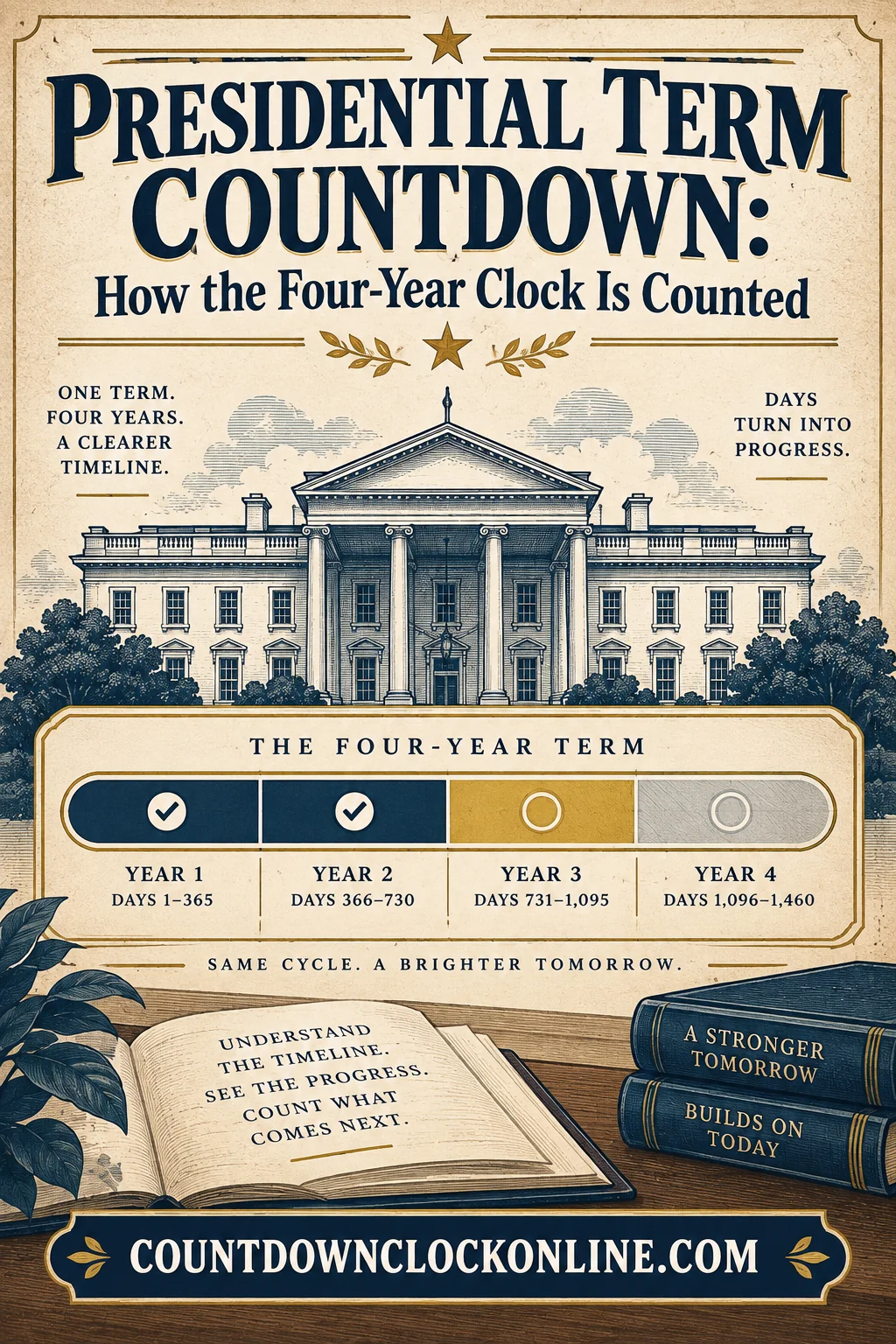
A United States presidential term is a fixed window of exactly four years that ends at noon on January 20, and it ends at that moment no matter who holds the office, when they took the oath, or what has happened in between. That fixed endpoint is what makes a countdown possible at all. You are not counting down a person's tenure. You are counting down a slot on the calendar that the Constitution defined in advance.
This page covers the mechanics only: the term length, the date and time it ends, the amendment that set that date, and how to work out the remaining time correctly. No opinions, no predictions, no politics. Just the clock.
How Long Is a Presidential Term?
Four years. The text is in Article II, Section 1 of the Constitution, which provides that the President "shall hold his Office during the Term of four Years," with the Vice President chosen for the same term.
Four years is not a fixed number of days in general, but a presidential term is, because of where it sits on the calendar. Every term runs from January 20 of a year to January 20 four years later, and every such span contains exactly one February 29. That makes the standard presidential term:
- 1,461 days
- 35,064 hours
- 208 weeks and 5 days
You can check it against any term. From noon on January 20, 2025 to noon on January 20, 2029: three ordinary years of 365 days plus the stretch containing February 29, 2028, giving 365 + 365 + 365 + 366 = 1,461.
There is exactly one exception in the entire Gregorian scheme, and it is a curiosity rather than a practical concern. Century years not divisible by 400 are not leap years, so the term running from January 20, 2097 to January 20, 2101 skips a February 29 and lasts 1,460 days. Every other term in living memory and for decades ahead is 1,461.
When Does the Presidential Term End?
At noon on January 20, in the year following each presidential election year.
Presidential elections fall in years divisible by four — 2024, 2028, 2032 — so terms end in years that leave a remainder of one when divided by four: 2025, 2029, 2033, 2037. If you ever need to work out which January 20 closes the term now running, take the most recent presidential election year and add one.
The authority is the Twentieth Amendment, ratified in 1933. Section 1 reads that the terms of the President and Vice President "shall end at noon on the 20th day of January," and that the terms of their successors "shall then begin." Two things follow from that wording, and both matter for anyone building a clock.
First, one term ends and the next begins at the same instant. There is no gap and no overlap. Noon on January 20 is a single boundary, not a handover period.
Second, the amendment fixes a time of day, not just a date. A countdown that runs to midnight on January 20 is twelve hours wrong. The convention is noon in the Eastern time zone, the local time of the capital, which in January is Eastern Standard Time — five hours behind Coordinated Universal Time. So the endpoint in UTC is 17:00 on January 20.
Why January 20, and Why Noon?
For nearly a century and a half, the handover happened on March 4. That date came from the schedule the outgoing Congress of the Confederation set when the government under the Constitution began operating in 1789, and it stuck.
March 4 made sense when election results traveled by horse and elected officials traveled by carriage. By the twentieth century it produced a four-month gap between an election and the start of the term it decided — a long stretch in which officials who had already been replaced remained in office with full powers. The Twentieth Amendment closed most of that gap, moving the presidential handover to January 20 and the start of a new Congress to January 3. It is sometimes called the Lame Duck Amendment for exactly that reason.
The choice of noon rather than midnight is a practical one. A daytime boundary means the transfer happens during working hours, in public, with both the outgoing and incoming officeholders present, rather than in the middle of the night.
The Term Is a Window, Not a Person's Tenure
This is the point that most countdown confusion comes from, and it is worth being precise about.
The four-year term belongs to the office, not the person. If the presidency changes hands partway through — by death, resignation, or removal — the successor serves out the remainder of the same term. The clock does not reset. January 20 four years after the term began is still the day it ends.
The same is true of the temporary arrangements under the Twenty-fifth Amendment, where powers and duties can be transferred to the Vice President for a period and then returned. Those transfers change who is exercising the office. They do not change the term's start or end date by a single second.
So a countdown to the end of a term is a countdown to a date fixed years in advance, unaffected by anything that happens in between. That is unusual among the things people count down to, and it is what makes this a clean timer to set.
The Oath Does Not Start the Clock
A related precision point: the term begins at noon on January 20 whether or not the oath of office has been administered.
Article II sets out the oath, and it must be taken before the officeholder can execute the office, but the Twentieth Amendment starts the term at a fixed moment regardless. In practice the oath is scheduled to be administered right around noon so the two line up, but if a ceremony runs a few minutes long, the term has already begun.
The Twentieth Amendment also anticipates the case where nobody has qualified for the office when the term begins, and Section 3 provides for how that is handled. The relevant point for a countdown is simply that the calendar boundary does not wait.
Working Out the Days Left in Presidential Term
The arithmetic is straightforward once you have the endpoint pinned down. To find the days left in presidential term:
- Identify the closing date: January 20 of the year after the most recent presidential election year.
- Set the moment to 12:00 noon Eastern Standard Time on that date, which is 17:00 UTC.
- Subtract the current moment from it.
- Divide by 86,400 seconds to get whole days, and keep the remainder for hours and minutes.
The reason to do it in seconds rather than by counting calendar days on your fingers is that partial days are where errors creep in. Counting from a Tuesday afternoon to a noon endpoint is not a whole number of days, and rounding it the wrong way puts you a day out.
Some fixed reference points inside any term, all measured from the noon start:
| Milestone | Days elapsed | Falls on |
|---|---|---|
| Term begins | 0 | Noon, January 20 |
| First year complete | 365 | Noon, January 20, year 2 |
| Halfway point | 730.5 | Midnight starting January 21, year 3 |
| Second year complete | 730 | Noon, January 20, year 3 |
| Third year complete | 1,095 | Noon, January 20, year 4 |
| Term ends | 1,461 | Noon, January 20, year 5 |
The halfway point is a small oddity worth noting. Half of 1,461 days is 730 and a half, so the exact midpoint of a presidential term is not noon on any day — it is midnight, at the start of January 21 in the term's third calendar year.
Setting an Inauguration Day Countdown
If you want an inauguration day countdown rather than a term countdown, it is the same instant viewed from the other side: the moment one term ends is the moment the next begins.
Three practical settings to get right:
Time zone. Set the target to noon Eastern, not noon local. If your clock lets you enter a UTC offset, January is standard time in the United States, so Eastern is UTC minus five. Daylight saving time is not in effect on January 20 in any year, which removes one common source of error.
Time of day. Noon, not midnight, not 9am when coverage typically begins. The constitutional boundary is 12:00.
The Sunday case. When January 20 falls on a Sunday, the term still begins at noon on the 20th and the oath is administered that day, while the large public ceremony has customarily been held on Monday the 21st. This has come up in 1877, 1917, 1957, 1985 and 2013. If you are counting to the constitutional moment, use the 20th regardless of the day of the week. If you are counting to a televised ceremony, check the announced schedule for that particular year.
Once you have those three settled, you can point a countdown timer at the exact moment and leave it running. Because the endpoint never moves, this is one of the few countdowns you can set once and never revise.
The Other Fixed Dates Around a Transition
The January 20 boundary is constitutional. Several other dates in the sequence are set by federal statute, which means Congress can and occasionally does adjust them.
| Event | Timing | Set by |
|---|---|---|
| Election Day | Tuesday after the first Monday in November, in years divisible by four | Federal statute |
| Electors meet in the states | First Tuesday after the second Wednesday in December | Federal statute |
| New Congress convenes | January 3 | Twentieth Amendment |
| Electoral votes counted in Congress | January 6, moving to January 7 when the 6th is a Sunday | Federal statute |
| Term ends and next term begins | Noon, January 20 | Twentieth Amendment |
Note the ordering: the new Congress is seated on January 3, more than two weeks before the presidential term boundary. That was a deliberate feature of the Twentieth Amendment, so that the count of electoral votes is carried out by the newly seated Congress rather than the outgoing one.
The Two-Term Limit and What It Means for the Clock
The Twenty-second Amendment, ratified in 1951, provides that no person shall be elected to the office of President more than twice, and that a person who has held the office or acted as President for more than two years of a term to which someone else was elected may be elected only once.
The arithmetic ceiling that falls out of this is ten years: up to two years inherited from someone else's term, plus two full elected terms of four years each. Anyone who takes over with more than two years remaining in another person's term is limited to one election of their own, which caps their total service below that.
For countdown purposes the amendment changes nothing about the clock itself. It constrains who may appear on a ballot, not when a term ends. Each term is still 1,461 days from noon to noon.
Common Counting Mistakes
Counting to midnight. The single most frequent error. The boundary is noon.
Using local time. A clock set to noon in a Pacific time zone runs three hours late against the constitutional moment.
Assuming the term resets on a change of officeholder. It does not. A successor finishes the existing term on the existing schedule.
Counting inclusive days by hand. "January 20 to January 20" spans 1,461 days, not 1,460 or 1,462. Subtract timestamps rather than counting boxes on a calendar.
Confusing the term with the ceremony. The public inaugural ceremony is scheduled around the constitutional moment; it is not the thing that creates it. When the two fall on different days, as they do when the 20th is a Sunday, the term boundary is still noon on the 20th.
Frequently Asked Questions
How long is a presidential term in days? 1,461 days, or 35,064 hours. Every four-year presidential term contains exactly one leap day, so the count is the same for every term, with a single far-off exception around the year 2100 when the century year is not a leap year and the term runs 1,460 days.
When does the presidential term end exactly? At noon Eastern Standard Time on January 20 of the year following a presidential election year, as fixed by Section 1 of the Twentieth Amendment. That is 17:00 UTC. The outgoing term ends and the incoming term begins at the same instant.
Does the term end date change if the officeholder changes partway through? No. The four-year term belongs to the office and is fixed to the calendar. A successor who takes over during a term serves the remainder of that same term, and the January 20 endpoint is unaffected.
Why is Inauguration Day on January 20 instead of March 4? The Twentieth Amendment, ratified in 1933, moved it. The original March 4 date left a four-month gap between an election and the start of the term it decided, which made sense when travel and communication were slow and became an obvious problem once they were not.

