

Printable Countdown Calendars: Formats That Actually Get Used
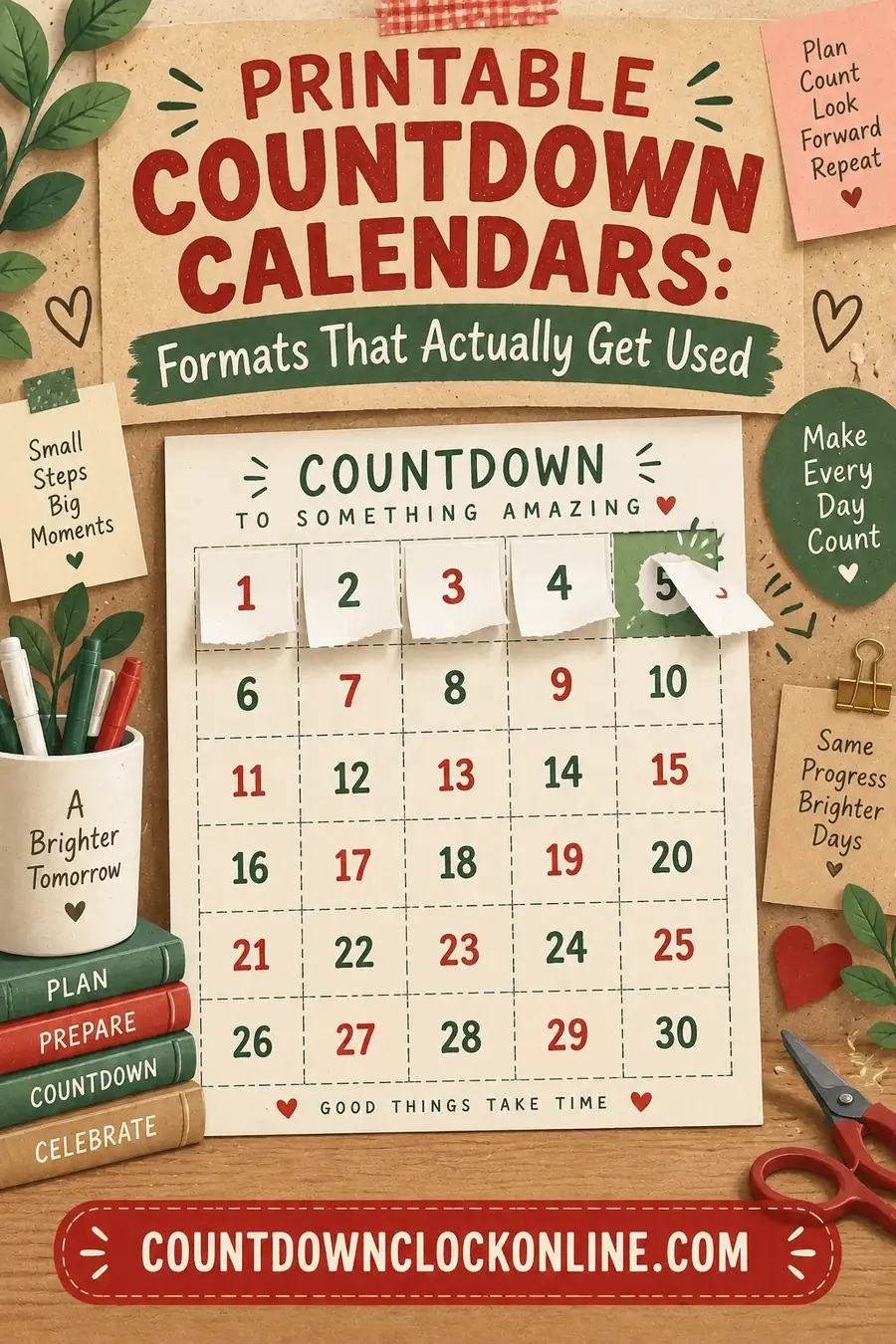
A countdown calendar only works if the daily action is small enough that nobody skips it — and the single best predictor of whether one survives past week one is whether marking a day takes under five seconds. Coloring a detailed illustration each day sounds lovely and gets abandoned by day four. Tearing off a strip does not.
Formats, and What They Suit
| Format | Best length | Daily action | Holds up because |
|---|---|---|---|
| Paper chain | 10-30 days | Tear off a link | Physically shrinks — visible progress |
| Tear-off strip chart | 14-60 days | Tear one number | Fast, satisfying, no supplies |
| Grid to cross off | 30-100 days | One X | Compact, works on a fridge |
| Numbered flip cards | 7-31 days | Flip one card | Reusable across events |
| Sticker chart | 14-40 days | Place a sticker | Strong for young children |
| Envelope advent style | 24-25 days | Open one | Best when each day holds something |
Match the format to the length. A paper chain for 100 days is unwieldy — it's physically enormous and drapes across a room. A grid for 10 days is anticlimactic, because crossing off ten boxes never feels like progress. The mismatch, more than anything else, is why countdown calendars get abandoned.
Why the Physical Version Beats a Digital One for Some Uses
A digital countdown is more accurate, works to the second, and can't be lost. It's the right tool for a deadline.
A printed one wins on three specific things:
Visibility without a device. It's on the wall. Nobody has to open anything, and it's seen by everyone in the room dozens of times a day.
A physical daily ritual. Tearing, crossing off or flipping is a small action that marks the passage of time in a way watching a number decrement does not. For children especially, this is most of the value.
Shrinking as evidence. A paper chain that started at the ceiling and now reaches the shelf shows progress at a glance, without reading anything. That's a different signal from "27 days remaining."
The two work well together — a wall chart for the household and a phone timer for the exact deadline.
Building Each Format
Paper chain. Cut strips roughly 1 inch by 8 inches, one per day. Number them if the count matters, or leave them blank if only the shrinking matters. Loop and glue into a chain, hang from a high point. Remove one link per day, from the bottom.
Tear-off strip chart. A single sheet with the days as a column of numbered strips, cut most of the way through so each tears off cleanly. Print on slightly heavier paper — thin paper tears unpredictably and takes the next day with it.
Grid. A simple table of numbered boxes, largest count top-left. The most compact option, and the only one that comfortably handles 100+ days. Print small and stick it on a fridge or inside a planner.
Flip cards. Numbered cards on a ring or in a small stand. The one genuinely reusable format — the same set works for every future countdown, which makes it worth printing on cardstock once.
Sticker chart. A grid of empty circles, one sticker per day. The sticker itself does the motivating for young children, and it's the format most likely to be maintained by a four-year-old without prompting.
Envelope style. Small numbered envelopes or pockets, each holding a note, a task, a small treat or an activity. The most work to build and the one people remember, because each day contains something rather than merely marking something.
Making It Last the Whole Countdown
Put it where the ritual naturally happens. Beside the kettle, on the fridge, next to a light switch. A calendar in a room nobody stands in gets forgotten regardless of format.
Assign the job to one person. If everyone can mark it, nobody does. Children take this responsibility unusually seriously if it's explicitly theirs.
Decide the rule for a missed day before it happens — usually "catch up all at once, no guilt." Countdown calendars die when someone misses three days and the chart now feels like evidence of failure.
Keep the daily action identical. Varying it — color on Monday, sticker on Tuesday — adds decisions, and decisions are friction.
For Classrooms
A few adjustments that matter with a group:
Make it big and put it at child height. If they can't reach it, it becomes the teacher's chart rather than theirs.
Rotate who marks the day. A named rota turns it into a small privilege and guarantees it gets done.
Pair the number with something learned. A countdown to the end of term where each day's strip holds a word, a fact or a question does double duty and gives the ritual content.
Choose an end point children actually care about. A countdown to a trip or a holiday works; a countdown to an administrative date does not.
Choosing the Right Length
Countdowns that run too long lose their meaning. Rough guidance:
- Under 7 days: barely worth a calendar; a note is enough
- 7-30 days: the sweet spot for any format
- 30-60 days: works with a grid or tear-off, but expect enthusiasm to dip in the middle
- 60-100 days: grid only, and consider marking weeks rather than days
- Over 100 days: a digital countdown is genuinely better; a physical one becomes a chore
Formats in Detail
Paper chain. Cut strips roughly one inch by eight, one per day, numbered if the count matters. Loop and glue into a chain and hang from a high point. Remove one link daily from the bottom. The shrinking is the entire appeal and it's why this format holds children's attention better than any other.
Tear-off strip chart. A single sheet with days as a numbered column, cut most of the way through so each strip tears cleanly. Print on slightly heavier paper — thin stock tears unpredictably and takes the next day with it.
Grid. A table of numbered boxes, highest count top-left. The most compact option and the only one that handles a hundred days comfortably. Best on a fridge or inside a planner.
Flip cards. Numbered cards on a ring. The one genuinely reusable format — the same set serves every future countdown, which makes cardstock and lamination worth it.
Sticker chart. A grid of empty circles, one sticker daily. The sticker does the motivating, and this is the format most likely to be maintained unprompted by a four-year-old.
Envelope or pocket style. Small numbered envelopes each holding a note, task, treat or activity. The most work to build and the one people remember, because each day contains something rather than merely marking something.
Matching Format to Occasion
| Occasion | Typical length | Best format |
|---|---|---|
| Holiday or trip | 14-30 days | Paper chain |
| New baby due date | 40-80 days | Grid |
| Wedding | 60-200 days | Grid, weeks not days |
| Return of a family member | 30-120 days | Tear-off or grid |
| End of term | 30-60 days | Sticker chart or tear-off |
| Product or project launch | 20-60 days | Tear-off |
| Personal goal | 30-90 days | Grid |
The general rule: the shorter the countdown, the more physical the format should be. A ten-day paper chain is delightful; a hundred-day one is furniture.
Making One With Children
Let them build it. The construction is half the value — cutting, gluing, numbering. A calendar a child made is a calendar a child maintains.
Number backwards, from the total down to one. Counting down is more motivating than counting up, and it makes "how many left" answerable at a glance.
Add small content where you can. A joke, a task, an activity, a fact. Turns a marking ritual into a daily moment.
Put it at their height. A calendar a child can't reach becomes the adult's job within a week.
Take a photo when it's finished and empty. The before-and-after is genuinely satisfying and worth having.
Why Physical Countdowns Work Psychologically
There's a genuine mechanism behind why a paper chain outperforms a phone timer for sustained anticipation.
Visible progress is motivating in a way that a number isn't. A chain that started at the ceiling and now reaches the shelf communicates progress without requiring anyone to read or interpret anything. The information is in the physical form.
A daily ritual creates a habit anchor. Tearing off a strip at the same moment each day builds a small routine, and routines are considerably more durable than intentions.
Shared visibility matters. A wall calendar is seen by everyone in the household dozens of times a day without anyone opening anything. A phone timer is seen by one person when they choose to look.
Anticipation is part of the pleasure. Research on looking forward to events consistently finds the anticipation itself carries real value — sometimes more than the event. A physical countdown extends and amplifies that period rather than just measuring it.
The action is a commitment device. Marking the day is a small daily act of engagement with the thing being awaited, which keeps it present in a way passive waiting doesn't.
Troubleshooting an Abandoned Calendar
Most countdown calendars die in week two. The causes are predictable.
Too long for the format. A hundred-day paper chain is unwieldy from day one. Match format to length.
The daily action takes too long. Anything over about thirty seconds gets skipped, then skipped again.
No clear owner. If everyone can do it, nobody does. Assign it.
It's in the wrong room. A calendar somewhere people don't stand gets forgotten regardless of how well made it is.
A missed stretch made it feel like failure. This is the big one. Agree in advance that catching up in one go is completely fine, and say so out loud when it happens.
The end point isn't motivating. A countdown to something nobody's excited about is just admin. If enthusiasm has faded, the problem may be the destination rather than the calendar.
Digital and Physical Together
The two formats aren't in competition, and most people who run a countdown well use both.
The physical one carries the household. It's on the wall, seen constantly, maintained by whoever owns it, and it does the anticipation work.
The digital one carries the precision. It knows the exact remaining time, handles the time zone, and doesn't depend on anyone remembering to update it.
Practically: a paper chain or grid on the fridge for the family, and a countdown clock on a phone for the person who actually needs to know whether there are eleven days or twelve. Neither replaces the other and running both costs nothing.
One caution: don't let the digital one become the authority that makes the physical one feel pointless. If a child asks how long is left and the answer always comes from a phone, the chain stops mattering. Let the chain answer the question.
Occasions Worth Building a Paper Countdown For
Some occasions suit a printed calendar better than a screen, and they tend to be the ones with a long, emotionally loaded run-up.
Christmas. Searches like "how many days until christmas countdown" climb from the first week of November and do not stop until the 24th. A paper advent calendar answers that question in the most satisfying way available: one door, one square, or one torn-off paper chain link per day, with the answer visible from across the room. It is also the only format that works for a child who cannot yet read a number of days off a screen.
Any other holiday countdown. The advent format is not owned by December. The same 24-door grid works for the weeks before Halloween, Easter, Diwali, Ramadan, or the summer break, and a general holiday countdown built this way gives you a reusable template you only have to design once.
A wedding. A marriage countdown runs for months rather than weeks, so a day-per-square grid becomes unwieldy - a week-per-square version, with one line to write what got done that week, doubles as a planning record you will actually want to keep afterward.
Mardi Gras. A Mardi Gras countdown has a fixed start most people forget: the season opens on Twelfth Night, January 6, and runs to Fat Tuesday, whose date moves every year with Easter. Print it fresh each season rather than reusing last year's dates.
Frequently Asked Questions
What's the best countdown calendar format for children? Paper chains for shorter countdowns and sticker charts for slightly longer ones. Both give a physical daily action and visible progress, which is what maintains a young child's interest far better than a number decreasing.
How long should a countdown calendar run? Between one week and about a month for most purposes. Under a week doesn't need a calendar; beyond a month, enthusiasm tends to sag in the middle unless you switch to a compact grid or mark weeks instead of days.
What happens if you miss a few days? Agree in advance that catching up all at once is fine. Most abandoned countdown calendars are abandoned after a missed stretch made the chart feel like a record of failure rather than a countdown.
Is a printed countdown better than a digital one? They do different jobs. A printed one is visible to a whole household without a device and gives a daily ritual; a digital timer is accurate to the second and can't be misplaced. Many people run both.

