Daylight Saving Time Countdown: When the Clocks Change Next
days until the clocks change US clocks change at 2:00 a.m. on the second Sunday in March and the first Sunday in November.
Make a clock-change countdownYour daylight saving time countdown is short right now: the clocks fall back one hour at 2:00 a.m. local time on Sunday, November 1, 2026. After that, they spring forward one hour at 2:00 a.m. on Sunday, March 14, 2027.
The rule behind those dates never changes from year to year. In the United States, daylight saving time starts on the second Sunday in March and ends on the first Sunday in November, with the switch happening at 2:00 a.m. local time. This guide shows the next several clock-change dates, explains which way the clocks move each time, lists the places that skip the change, and gives you a simple three-day plan to ease your sleep and a checklist for the clocks that won't change themselves.
The next clock changes at a glance
Here are the upcoming clock changes, worked out from the second-Sunday-in-March and first-Sunday-in-November rule.
| Date | Change | What the clock does | Sleep that night |
|---|---|---|---|
| Sunday, November 1, 2026 | Fall back (DST ends) | 2:00 a.m. becomes 1:00 a.m. | One extra hour |
| Sunday, March 14, 2027 | Spring forward (DST starts) | 2:00 a.m. becomes 3:00 a.m. | One hour less |
| Sunday, November 7, 2027 | Fall back (DST ends) | 2:00 a.m. becomes 1:00 a.m. | One extra hour |
| Sunday, March 12, 2028 | Spring forward (DST starts) | 2:00 a.m. becomes 3:00 a.m. | One hour less |
| Sunday, November 5, 2028 | Fall back (DST ends) | 2:00 a.m. becomes 1:00 a.m. | One extra hour |
The old saying still works: spring forward, fall back. In spring, the clock jumps ahead an hour, so you lose an hour of sleep. In fall, it slips back an hour, so you gain one.
Set up your own daylight saving time countdown
Make a live timer to the exact moment of the switch in under a minute, and it'll tick down to the second.
- Open the countdown creator.
- Name it something like "Clocks Fall Back" or "Spring Forward."
- Pick the date from the table above and set the time to 2:00 a.m.
- Choose a theme and press Start countdown.
- Copy the share link and send it to your family group chat, or bookmark it on your phone.
A daylight saving time countdown is handy for more than curiosity. Parents use it to time the bedtime shift for kids, shift workers use it to plan around a longer or shorter overnight, and anyone with an early Sunday commitment uses it as a reminder to double-check their alarm. If you just want a timer to a particular hour on any given day, you can also count down to a specific time.
One thing to keep in mind: your countdown follows your device's clock. Because the change happens at 2:00 a.m. local time in each time zone, people in New York, Chicago, Denver, and Los Angeles each hit the switch at their own 2:00 a.m., one after another through the night.
How the rule works
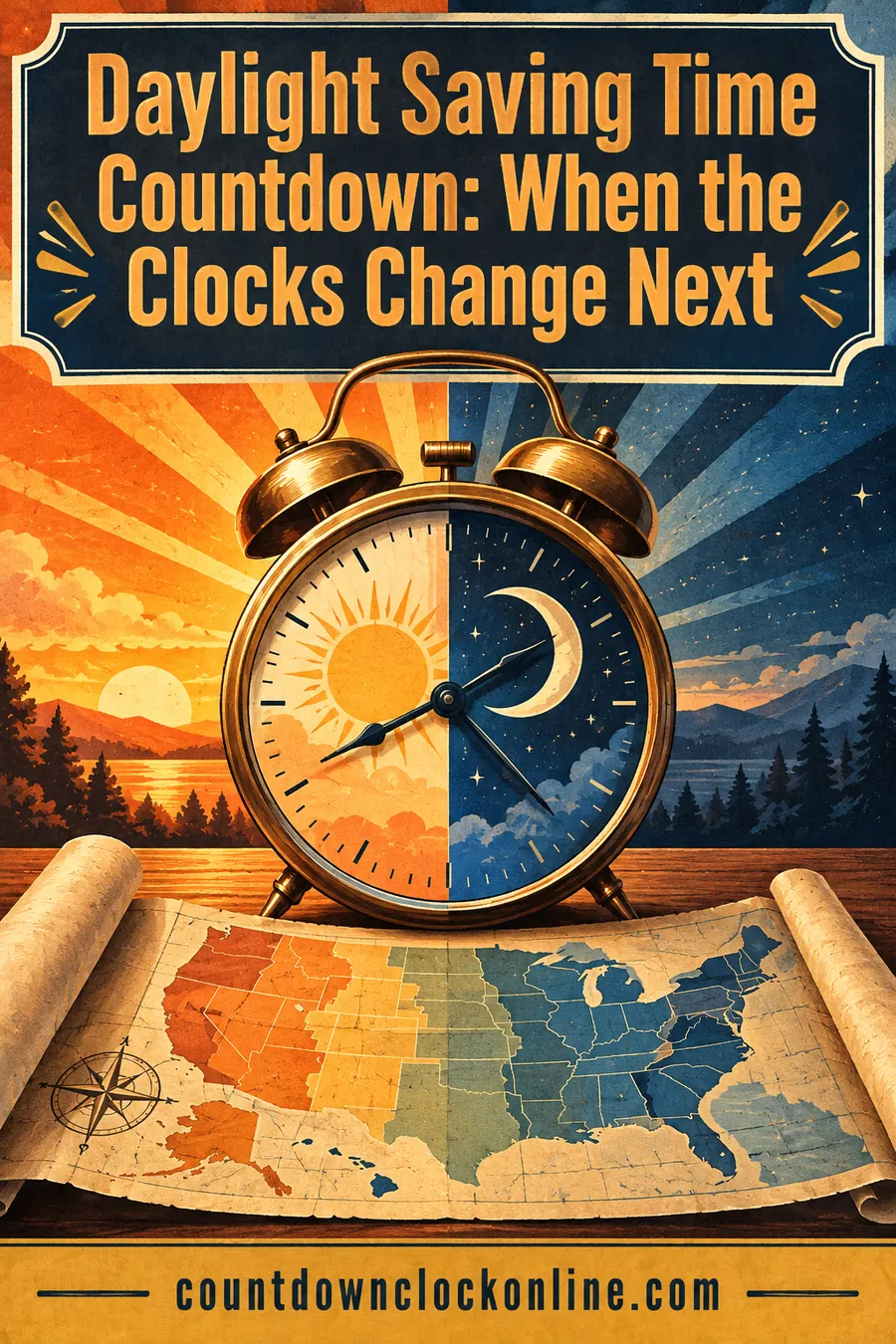
Daylight saving time in the US starts on the second Sunday in March and ends on the first Sunday in November, at 2:00 a.m. local time.
That one sentence covers everything, but here's what it means in practice:
- Starting date range. The second Sunday in March always falls between March 8 and March 14.
- Ending date range. The first Sunday in November always falls between November 1 and November 7.
- Always a Sunday. The switch happens overnight from Saturday into Sunday, a quiet stretch of the week for most households.
- Always at 2:00 a.m. local time. In spring, the clock goes from 1:59 a.m. straight to 3:00 a.m., so the 2 o'clock hour never happens that night. In fall, the clock reaches 1:59 a.m. and goes back to 1:00 a.m., so the 1 o'clock hour happens twice.
To find the dates for any year, look at a calendar for March and count to the second Sunday, then look at November and find the first Sunday. That's all there is to it.
Which way do the clocks go?
In March the clocks move forward one hour. In November they move back one hour.
Here's what each change means for your daily life:
| Spring forward (March) | Fall back (November) | |
|---|---|---|
| Clock change | Ahead 1 hour | Back 1 hour |
| Sleep that night | One hour less | One extra hour |
| Mornings afterward | Darker for a few weeks | Lighter |
| Evenings afterward | Lighter, sunset feels later | Darker, sunset comes early |
| Hardest part | Waking up Monday morning | Darker drive home from work or school |
People often find the spring change harder because it takes an hour away, but the fall change has its own challenge: suddenly darker evenings, often right around the busy run-up to the holidays.
Places that skip the clock change
Not every part of the US changes its clocks. Hawaii and most of Arizona stay on standard time all year.
- Hawaii does not observe daylight saving time.
- Arizona does not observe it, with one exception: the Navajo Nation, which covers part of northeastern Arizona, does change its clocks.
- US territories, including Puerto Rico, Guam, the US Virgin Islands, American Samoa, and the Northern Mariana Islands, do not observe it.
This matters if you work with people or family in those places. For half the year, the time difference between you shifts by an hour. For example, Arizona lines up with Mountain time in winter and with Pacific time in summer. If you schedule calls across time zones, double-check the gap the week after each change.
A 3-day sleep-shift plan
Shift your bedtime and wake-up time by about 15 to 20 minutes a day for three days before the change, and the switch will barely register.
This simple plan works for adults and is especially helpful for families with young kids, who tend to feel the change the most. It's general guidance only. If you have a sleep condition or a specific health concern, check with your doctor.
Before springing forward (March)
| Day | Bedtime | Wake-up |
|---|---|---|
| Thursday | 15 minutes earlier than usual | 15 minutes earlier |
| Friday | 30 minutes earlier than usual | 30 minutes earlier |
| Saturday | 45 minutes earlier than usual | 45 minutes earlier |
| Sunday (clocks change) | Your normal bedtime on the new clock | Your normal wake-up on the new clock |
By Sunday you've already made up most of the lost hour.
Before falling back (November)
| Day | Bedtime | Wake-up |
|---|---|---|
| Thursday | 15 minutes later than usual | 15 minutes later |
| Friday | 30 minutes later than usual | 30 minutes later |
| Saturday | 45 minutes later than usual | 45 minutes later |
| Sunday (clocks change) | Your normal bedtime on the new clock | Your normal wake-up on the new clock |
The fall change is usually easier, but early risers and little kids often wake up an hour "early" for a few days afterward. Shifting later beforehand helps prevent that.
Other things that help
- Get morning light. Step outside or open the blinds soon after you wake up, especially the week after the spring change.
- Keep meals on the new clock. Eating at your usual times on the new schedule helps your body catch up.
- Go easy on the weekend. Skip the late Saturday night right before the spring change.
- Be careful on the road. The first few mornings after the spring change can feel groggy. Leave a little extra time.
Your clock-change checklist
Phones and computers usually update on their own, but plenty of clocks in your home won't.
Run through this list on Saturday night or Sunday morning:
- Oven and microwave clocks
- Car dashboard clock
- Wall clocks and bedside alarm clocks
- Thermostat schedules
- Sprinkler and outdoor lighting timers
- Coffee maker timers
- Pet feeders on a schedule
- Fitness watches that don't sync automatically
- Security cameras and doorbells with date stamps
While you're going around the house, many families also use the clock change as a twice-a-year reminder to test smoke and carbon monoxide alarms and to swap batteries where needed. It's an easy habit to pair with the switch.
Check your phone settings
Most phones and computers change automatically, but only if the time-zone setting is on automatic. If you set your time zone manually at some point, your device may not switch. Check it the evening before.
Ideas for the extra (or lost) hour
A clock change is a natural twice-a-year checkpoint, so it's worth planning what to do with the hour.
When the clocks fall back in November, you get an extra hour on Sunday. A few ways families use it:
- Sleep in, guilt-free.
- Make a slow breakfast together.
- Do a quick home safety check: alarms, flashlights, and the first-aid kit.
- Swap out summer gear for cold-weather coats, hats, and gloves.
- Take an early walk while it's lighter in the morning.
When the clocks spring forward in March, you lose an hour, so the goal is to make Sunday easy:
- Plan a quiet day with nothing scheduled early.
- Prep Monday's lunches and outfits on Sunday afternoon.
- Head outside in the longer evening light for a walk or a backyard dinner.
- Go to bed a little early Sunday night to protect Monday morning.
Keeping a daylight saving time countdown on your phone makes these little routines easy to remember, since you'll see the change coming a few days ahead instead of discovering it Sunday morning.
Mistakes to avoid
Most clock-change headaches come from a missed alarm or a calendar invite set in the wrong time zone.
- Trusting an old-style alarm clock. If it doesn't update itself, it'll be an hour off Sunday morning. Change it before bed.
- Booking early Sunday plans without thinking. A 7:00 a.m. flight or shift on the spring-forward morning comes an hour sooner than your body expects.
- Scheduling overnight tasks between 1:00 and 3:00 a.m. Some timers skip the 2 o'clock hour in spring or run twice in the 1 o'clock hour in fall. Move them earlier or later.
- Forgetting other people's time zones. Friends in Hawaii or Arizona don't change. Other countries that change their clocks often do it on different dates, so check before scheduling international calls.
- Mixing up the clock change with the season change. The first day of spring and the first day of fall are set by the equinoxes, not by the clock change. They're close in March but weeks apart in the fall.
Clock changes vs. the change of seasons
The clock change and the equinox are two different events that happen on different days.
The spring clock change comes on the second Sunday in March, while the first day of spring arrives at the March equinox, usually around March 19 to 21. In fall, the equinox comes in late September, but the clocks don't fall back until early November. If you're counting down to warmer weather, track the first day of spring countdown. If you're looking forward to cozy autumn, the first day of fall countdown has you covered. And for the clock switch itself, set your own daylight saving time countdown with the creator so it ticks right up to 2:00 a.m.
days until the clocks change US clocks change at 2:00 a.m. on the second Sunday in March and the first Sunday in November.
Make a clock-change countdownFAQ
When do the clocks change next?
The clocks fall back one hour at 2:00 a.m. local time on Sunday, November 1, 2026. They spring forward one hour at 2:00 a.m. on Sunday, March 14, 2027.
What is the rule for daylight saving time in the US?
It starts on the second Sunday in March and ends on the first Sunday in November, at 2:00 a.m. local time.
Do I lose or gain an hour of sleep?
You lose an hour in March, when the clocks spring forward, and gain an hour in November, when they fall back.
Which states don't change their clocks?
Hawaii and most of Arizona stay on standard time all year. The Navajo Nation in Arizona does change its clocks. US territories such as Puerto Rico and Guam don't change either.
Will my phone change the time automatically?
Usually, yes, as long as its date and time settings are set to automatic. Check that setting the evening before, and change any standalone clocks by hand.
What happens to the 2:00 a.m. hour?
In March, the clock goes from 1:59 a.m. straight to 3:00 a.m., so that hour is skipped. In November, the clock goes from 1:59 a.m. back to 1:00 a.m., so the 1 o'clock hour happens twice.
How do I make a daylight saving time countdown?
Open the countdown creator, name your event, set the date of the next change with a time of 2:00 a.m., pick a theme, and press Start countdown. You'll get a link you can bookmark or share.
days until the clocks change US clocks change at 2:00 a.m. on the second Sunday in March and the first Sunday in November.
Make a clock-change countdown