Kwanzaa 2026 Countdown: Seven Days From December 26
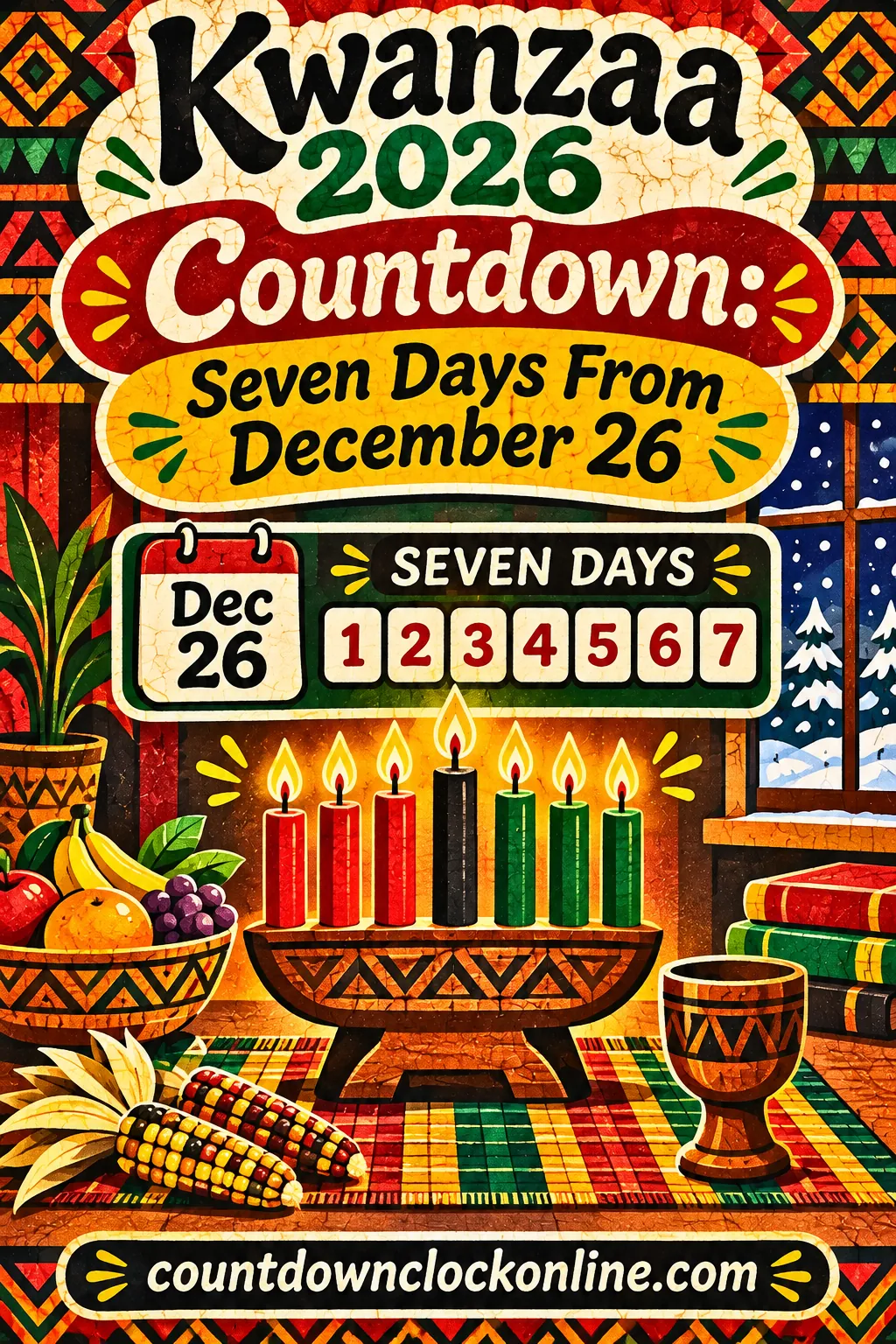
Kwanzaa 2026 begins on Saturday, Dec. 26, 2026 and runs seven days through Friday, Jan. 1, 2027, with one principle and one candle for each day and the karamu feast traditionally on Thursday, Dec. 31. The dates are the same every year, so once you know them, the only question is how many days are left.
A free Kwanzaa countdown opens already set to the first moment of Dec. 26. Share it with family, put it on the TV, or make a second one for the feast night.
This guide gives you the full day-by-day calendar, how to set up the countdown with exact settings, a three-week prep timeline, ideas for families with kids, classrooms and community groups, and answers to the questions people ask most.
Kwanzaa 2026 Dates at a Glance
Kwanzaa was created in 1966 by Dr. Maulana Karenga as a week-long celebration of African American family, community and culture. Its name comes from the Swahili phrase "matunda ya kwanza," which means "first fruits." It's a cultural holiday, not a religious one, so families of any faith can celebrate it, and many celebrate it alongside other December holidays.
Each of the seven days is dedicated to one of the Nguzo Saba, the seven principles. Here's how they fall in 2026:
| Day | Date | Weekday | Principle | Meaning |
|---|---|---|---|---|
| 1 | Dec. 26, 2026 | Saturday | Umoja | Unity |
| 2 | Dec. 27, 2026 | Sunday | Kujichagulia | Self-determination |
| 3 | Dec. 28, 2026 | Monday | Ujima | Collective work and responsibility |
| 4 | Dec. 29, 2026 | Tuesday | Ujamaa | Cooperative economics |
| 5 | Dec. 30, 2026 | Wednesday | Nia | Purpose |
| 6 | Dec. 31, 2026 | Thursday | Kuumba | Creativity |
| 7 | Jan. 1, 2027 | Friday | Imani | Faith |
A few things stand out this year:
- It starts on a weekend. Dec. 26 is a Saturday, so the first two days fall on Saturday and Sunday, which makes it easier for families to gather for the opening night.
- The feast falls on a weeknight. Dec. 31 is a Thursday. Since it's also New Year's Eve, many people are already off work or planning a late night.
- It ends on a holiday. Jan. 1, 2027 is a Friday and New Year's Day, so the last day of Kwanzaa runs into a long weekend.
When does Kwanzaa start each night?
The principle of the day is usually discussed and its candle lit in the evening, when the family comes together. Some families light the candles at dinner, others before bed. There's no single required hour, so pick a time that works for your household and stick with it all week. That's the time you'll want to use for any countdown to a specific night.
Why the dates never change
Kwanzaa is tied to fixed calendar dates, not to a moon phase or a weekday. It always runs from Dec. 26 through Jan. 1. Only the days of the week shift from year to year. That's handy for planning, because a countdown you make once can roll over on its own every year (more on that below).
| Year | First day (Dec. 26) | Karamu (Dec. 31) | Last day (Jan. 1) |
|---|---|---|---|
| 2026 | Saturday | Thursday | Friday, Jan. 1, 2027 |
| 2027 | Sunday | Friday | Saturday, Jan. 1, 2028 |
| 2028 | Tuesday | Sunday | Monday, Jan. 1, 2029 |
How Many Days Until Kwanzaa 2026?
If you're counting from a common starting point, here's how much time you have until the first day, Dec. 26, 2026:
- From Thanksgiving, Thursday, Nov. 26: 30 days
- From Tuesday, Dec. 1: 25 days
- From Thursday, Dec. 10: 16 days
- From Sunday, Dec. 20: 6 days
- From Christmas Day, Friday, Dec. 25: 1 day
The live countdown does this math for you every second, in days, hours, minutes and seconds. It also shows a row of extra counts under the big numbers. Here's what that row looks like on Tuesday, Dec. 1, 2026 at noon:
- 25 sleeps. Nights left until Dec. 26.
- 3 weeks. Full weeks left.
- 4 weekends. Saturdays between tomorrow and Dec. 26, including Dec. 26 itself.
- 18 work days. Weekdays from tomorrow through Dec. 26.
The work days count includes Christmas Day, because the tool counts every Monday through Friday and doesn't know about holidays. Treat it as a rough guide if you're planning around a work schedule.
The sleeps number is the one kids love. "Twenty-five sleeps" is easier to picture than a date on a calendar, and watching it drop each morning builds a little excitement into December.
How to Set Up Your Kwanzaa Countdown With the Free Tool
The countdown maker is free and works in any modern browser on a phone, tablet or computer. There's no app and no account.
Step 1: Open the ready-made countdown
Tap the Kwanzaa 2026 countdown. It opens with these settings filled in:
- Event name: Kwanzaa begins
- Date: December 26, 2026
- Time: 00:00, the very start of the day
- Theme: Sunshine, a bright, warm look with floating suns and sunflowers
The clock starts right away. You'll see the full date under the title, the big days, hours, minutes and seconds, and the stats row underneath.
Step 2: Make it yours
Tap Edit this countdown to jump to the form. Your changes show on the countdown as you make them.
- Event name. Up to 60 characters. Try "Kwanzaa," "The Johnson Family Kwanzaa" or "Kwanzaa at Grandma's." Here's a small tip: when the countdown reaches zero, it shows a banner that reads your event name followed by "is here!" A name like "Kwanzaa" gives you "Kwanzaa is here!" which reads more naturally than "Kwanzaa begins is here!"
- Date. Leave it at Dec. 26, 2026 for the first day.
- Time. Leave it at 00:00 to count to the start of the day, or set it to the hour your family lights the first candle, like 6:00 PM. A countdown to the actual gathering feels more exciting than one that hits zero while everyone's asleep.
- Theme. There's no theme made just for Kwanzaa, so pick a look that suits your family. Sunshine is bright and warm. Midnight is a calm night sky with twinkling stars, nice for an evening candle-lighting. Party Pop has balloons and confetti for a more festive feel. Minimal Mono is plain and clean for a classroom or office.
Press Start countdown when it looks right.
Step 3: Decide whether to repeat it every year
Under the form there's a Repeat every year box. Since Kwanzaa always starts on Dec. 26, this is one of the few holiday countdowns where it makes real sense. Tick the box and the share link keeps working year after year.
Here's how it behaves: the countdown hits zero on Dec. 26, stays there for that day, and once a full day has passed it rolls over to Dec. 26 of the next year. That means during days two through seven, a repeating countdown will already be pointing at 2027. If you want a clock that tracks the week itself, make a second countdown to the feast or to Jan. 1 (see Step 5).
Tap Add to calendar on a repeating countdown and the calendar file it downloads repeats yearly too, with a reminder the day before.
Step 4: Save it and share it
Tap Save to my countdowns so it's stored in your browser. Then tap Copy share link and send it to the family group chat, the class newsletter or your community group. The link carries the name, date, time and theme, so everyone sees the same countdown.
Under the share box there's a set of ready-made lines, such as "25 sleeps till Kwanzaa!" Tap one and it's shared (or copied) with the live link attached, an easy way to send a reminder without typing anything.
The buttons along the top of the countdown give you a few more options:
| Button | What it does | Kwanzaa idea |
|---|---|---|
| Save image | Makes a tall or square picture of the countdown | Print it for the fridge or post it for relatives who don't open links |
| Fullscreen | A big, clean countdown with nothing else on screen | Put it on the TV during the last few minutes before the first candle |
| Add to calendar | Downloads an all-day calendar event with a reminder one day before | Everyone gets a nudge on Christmas Day that Kwanzaa starts tomorrow |
| Embed | Gives you code for a live countdown on a web page | Add it to a church, school or community center page |
| Copy share link | Copies the live link | Paste it into every invitation and reminder |
The time you set is read in your own device's time zone. When you share the link, each person counts down to the same moment in their own local time. If you set 6:00 PM in Atlanta for a video call, a cousin in Denver sees it end at 4:00 PM their time, right when yours does. If you'd rather everyone light candles at 6:00 PM in their own town, tell each household to make its own countdown instead of sharing one link.
Step 5: Make a second countdown for the karamu
The first countdown gets you to Dec. 26. A second one keeps the feast night in view.
- Tap Make another. Your first countdown stays saved.
- Name it "Karamu feast" or "Kwanzaa karamu at Aunt Dee's."
- Set the date to Dec. 31, 2026 and the time to when dinner starts, like 6:00 PM.
- Pick a theme. Party Pop works well for a big gathering.
- Press Start countdown, then Save to my countdowns.
Or skip the typing and open a ready-made karamu countdown set to 6:00 PM on Dec. 31, then change the time to match your plans.
Now both countdowns sit side by side and keep ticking. You can keep up to 12 in one browser, so there's room for a candle-lighting countdown for each night if your kids want one. Saved countdowns stay in the browser where you made them, so if you want them on your phone too, open the share links there.
From Tuesday, Dec. 1 at noon, the karamu countdown shows 30 sleeps, 4 weeks, 4 weekends and 22 work days. From Thursday, Dec. 10 at 9:00 AM it shows 21 sleeps, while the first-day countdown shows 16.
The Karamu: Dec. 31 or Jan. 1?
If you've seen two different dates for the karamu, you're not imagining it. The feast is traditionally held on Dec. 31, the sixth day of Kwanzaa, which is dedicated to Kuumba (creativity). That's the date given by most Kwanzaa guides.
Some sources and community events list it differently, though. A few put it on Jan. 1, and many community centers hold a public karamu on whatever weekend night works best for their space. In 2026, that could mean a gathering on Saturday, Dec. 26 or Sunday, Dec. 27.
Here's a simple way to settle it for your family:
- If you're hosting at home, Dec. 31 is the traditional choice. It's Thursday, Dec. 31 in 2026.
- If you're going to a community event, use the date and time on its invitation, not a general guide.
- If your family has its own tradition, keep it. Kwanzaa is meant to be practiced in a way that strengthens your family and community.
Whatever date you choose, put it on its own countdown so nobody mixes up the opening night and the feast night.
What usually happens at a karamu
A karamu is a big, joyful meal shared with family and friends. Many include:
- A welcome and an opening talk about the meaning of the gathering
- Remembering ancestors and elders, often with a libation of water poured from the unity cup, the kikombe cha umoja
- Music, drumming, dance, poetry and storytelling
- A shared meal, often potluck style, with dishes from across the African diaspora
- A closing talk and a farewell statement
There's no fixed menu. Families often bring recipes that mean something to them, from greens and black-eyed peas to jollof rice, gumbo, plantains, cornbread or sweet potato pie. Ask each guest to bring one dish and share the story behind it. It turns the meal into a lesson in Kuumba all on its own.
The Seven Candles: What to Light Each Night
The kinara (candle holder) holds seven candles, called the mishumaa saba: one black, three red and three green. The black candle sits in the center and stands for the people. The red candles stand for the struggle, and the green candles stand for the future and hope.
How the lighting goes
On the first night, you light only the black candle in the center for Umoja. On each night after that, you light the candles from the nights before and then one new one. By Jan. 1, all seven are burning.
A common pattern after the first night is to alternate between the red and green sides, starting with a red candle and working from the outside in. Some families light from left to right instead. Different guides describe it a little differently, so follow your family's or community's custom, and don't worry about getting it "wrong."
| Night | Date | Candles lit | Principle |
|---|---|---|---|
| 1 | Sat., Dec. 26 | 1 (black) | Umoja |
| 2 | Sun., Dec. 27 | 2 | Kujichagulia |
| 3 | Mon., Dec. 28 | 3 | Ujima |
| 4 | Tue., Dec. 29 | 4 | Ujamaa |
| 5 | Wed., Dec. 30 | 5 | Nia |
| 6 | Thu., Dec. 31 | 6 | Kuumba |
| 7 | Fri., Jan. 1 | 7 | Imani |
Each evening, a family member lights the candle and someone shares a few words about that day's principle. Many families use the Swahili greeting "Habari gani?" which means "What's the news?" The answer is the name of the day's principle, like "Umoja!" on the first night.
Candle safety
Kids love lighting the kinara, so keep it safe:
- Let an adult or older teen do the lighting, with younger kids choosing the candle or saying the principle.
- Set the kinara on a stable, heat-safe surface away from curtains, paper decorations and the edge of the table.
- Never leave lit candles unattended, and blow them out before everyone leaves the room or goes to bed.
- Battery candles are a fine choice for classrooms, apartments with strict rules or homes with very young children.
The other symbols on the table
The kinara sits on a mkeka, a woven mat that stands for the foundation of tradition. Other symbols often placed on the mat include:
| Symbol | Swahili name | What it stands for |
|---|---|---|
| Mat | Mkeka | Tradition and history as a foundation |
| Candle holder | Kinara | Ancestors and roots |
| Seven candles | Mishumaa saba | The seven principles |
| Crops (fruits and vegetables) | Mazao | The harvest and the rewards of shared work |
| Ears of corn | Muhindi | Children and the future, often one ear per child |
| Unity cup | Kikombe cha umoja | Unity and remembering ancestors |
| Gifts | Zawadi | Commitment, often given to children, frequently handmade or educational |
A Three-Week Kwanzaa Prep Timeline
Kwanzaa lands right after Christmas, when a lot of families are already stretched thin. Starting early keeps it from feeling rushed. Here's a timeline that works backward from Saturday, Dec. 26, 2026.
| When | What to do |
|---|---|
| Sat., Dec. 5 | Make and share your countdown. Check that you have a kinara, seven candles and a mkeka, or plan to make them. |
| Dec. 6 to 12 | Decide on your karamu date, time and place. Send invitations with the countdown link. |
| Dec. 13 to 19 | Start handmade zawadi with the kids. Pick books or stories to read for each principle. |
| Sun., Dec. 20 | Six days out. Make a simple plan for each night (see the ideas below). Ask karamu guests what they're bringing. |
| Dec. 21 to 23 | Gather crops for the mazao and ears of corn for the muhindi. Buy or check candles. |
| Thu., Dec. 24 | Set up the table display, or plan to set it up Dec. 26 if your Christmas decor is still out. |
| Fri., Dec. 25 | The calendar reminder arrives. Lay out the mkeka and kinara for the next day. |
| Sat., Dec. 26 | Light the black candle for Umoja. |
| Thu., Dec. 31 | Karamu. |
| Fri., Jan. 1 | Light all seven candles for Imani. Give zawadi if that's your family's custom. |
If you're starting late, don't worry. You can make a kinara from a piece of wood or a sturdy cardboard tube, cut a mkeka from paper strips, and still light the first candle on time. What matters is gathering and talking about the principles together.
If your countdown looks off
| Problem | Fix |
|---|---|
| It ends at midnight, but you light candles at dinner | Tap Edit this countdown and set the Time box to your candle-lighting hour. |
| The banner says "Kwanzaa begins is here!" | Change the event name to just "Kwanzaa" so the banner reads "Kwanzaa is here!" |
| A repeating countdown already shows next year on Dec. 28 | That's how repeat works. Make a separate countdown to Dec. 31 or Jan. 1 for the week itself. |
| A relative in another time zone sees a different end time | Each person sees the same instant in their local time. For a local start everywhere, have each household make its own. |
| Your saved countdowns aren't on your phone | They're stored in the browser where you made them. Open the share links on your phone and save them there. |
| The saving button doesn't work | Private browsing windows may block saving. Try a normal window. |
Day-by-Day Ideas for Each Principle
Each night is a chance to talk about one principle and do something small that puts it into practice. Here are simple ideas for each day. Pick one or two per night, not all of them.
Day 1, Sat., Dec. 26: Umoja (unity)
Unity in the family, community, nation and race. Light the black candle, then go around the table and have each person name one thing that holds your family together. Look at old family photos, or call an elder and ask them to share a memory of a time the family pulled together.
Day 2, Sun., Dec. 27: Kujichagulia (self-determination)
Defining and speaking for ourselves. Have each person write or draw something about who they are and who they want to become. Kids can make a name poster with the meaning of their name. Teens might write a short personal statement or list goals for the new year.
Day 3, Mon., Dec. 28: Ujima (collective work and responsibility)
Building and maintaining community together. Do a project as a team: clean up a room, a yard or a neighbor's walkway, or sort clothes and books to donate. Talk about one problem in your community and one small thing your family could do to help.
Day 4, Tue., Dec. 29: Ujamaa (cooperative economics)
Building and supporting shared businesses and resources. Talk about local Black-owned businesses in your area and why supporting them matters. Kids can plan a pretend shop, or the family can make a list of local places to visit in the new year.
Day 5, Wed., Dec. 30: Nia (purpose)
Working together to build and develop the community. Have everyone share one goal for 2027 that helps someone besides themselves. Write them on cards and keep them on the table through Jan. 1.
Day 6, Thu., Dec. 31: Kuumba (creativity)
Leaving the community more beautiful than you found it. This is karamu night, so creativity is everywhere: music, dance, poetry, decorations and food. Kids can make a paper chain in black, red and green, decorate place cards or perform a short poem they wrote.
Day 7, Fri., Jan. 1: Imani (faith)
Believing in our people, families, teachers and leaders. Light all seven candles. Share what each person believes about the year ahead. If your family gives zawadi, this is a traditional day to do it. Many families focus on handmade gifts, books or something that helps a child learn.
Ideas by Age and Group
Kwanzaa looks a little different in a house with toddlers than in a classroom of fifth graders. Here's how to adjust.
Young kids (ages 3 to 6)
Keep each night short, about 10 to 15 minutes. Let them choose which candle comes next (with an adult lighting it), say "Habari gani?" together and do one simple craft. The countdown's sleeps number works well at this age. Show it at breakfast every morning in December.
Older kids and tweens (ages 7 to 12)
Give them a job each night: one reads the principle, one leads the greeting, one explains a symbol. They can make the paper mkeka, write the karamu place cards or plan a small skit for Kuumba night.
Teens
Ask teens to lead a night. They can pick the principle that means the most to them, research a figure from history who lived it out, and share it with the family. Teens often enjoy making the countdown too, picking the theme and sending the link to cousins.
Classrooms
Kwanzaa falls during winter break for most US schools, so classrooms usually learn about it in the week or two before. Set a countdown to Dec. 26 on the board using Fullscreen, and teach one principle a day in the last seven school days before break. Use battery candles instead of real flames, and keep it educational: the history, the principles and the symbols.
Community groups and churches
Make a countdown to your public karamu, use the Embed button to put it on your website, and paste the share link into every flyer and email. If you hold an event on a weekend instead of Dec. 31, say so clearly in the event name, like "Community Karamu, Sat. Dec. 26," so nobody confuses it with the traditional date.
Families in different cities
Pick one night for a video call, like the first candle on Dec. 26 or the karamu on Dec. 31. Make one shared countdown to that call and send the link. Since the countdown ends at the same instant everywhere, nobody joins too early or too late. Each household lights its own candle on camera.
Start Your Kwanzaa 2026 Countdown
Kwanzaa 2026 runs from Saturday, Dec. 26 through Friday, Jan. 1, 2027, with the karamu traditionally on Thursday, Dec. 31. A countdown keeps those dates in front of everyone, from the kids watching the sleeps drop to the cousins coming in for the feast.
Open the free Kwanzaa countdown, set the time to your first candle-lighting, tick Repeat every year if you'd like the same link next December, and share it with your family.
If you celebrate more than one holiday this season, the site has ready-made clocks for those too. The Christmas countdown runs to Dec. 25, and the New Year countdown lands on the same day as Imani. For a paper version kids can color in each morning, try the printable countdown calendar, and for more ways to mark the season, see the holiday countdown page.
Frequently Asked Questions
When is Kwanzaa 2026?
Kwanzaa 2026 begins on Saturday, Dec. 26, 2026 and ends on Friday, Jan. 1, 2027. It lasts seven days, with one principle for each day. The dates are the same every year.
How many days until Kwanzaa 2026?
From Dec. 1, 2026 there are 25 days until Kwanzaa begins on Dec. 26. From Dec. 10 there are 16 days, and from Dec. 20 there are 6. The free countdown shows the exact days, hours, minutes and seconds from right now.
What night is the karamu feast in 2026?
The karamu is traditionally held on Dec. 31, the sixth day, which is Thursday, Dec. 31 in 2026. Some sources list Jan. 1, and community events often pick a convenient weekend night. If you're attending an event, go by its invitation.
What are the seven principles of Kwanzaa in order?
In order, they're Umoja (unity), Kujichagulia (self-determination), Ujima (collective work and responsibility), Ujamaa (cooperative economics), Nia (purpose), Kuumba (creativity) and Imani (faith). One principle is the focus of each day, from Dec. 26 through Jan. 1.
Which Kwanzaa candle do you light first?
The black candle in the center is lit first, on Dec. 26, for Umoja. Each night after that you relight the earlier candles and add one more. Families differ on the order of the red and green candles, so follow your own family's or community's custom.
Can I make a Kwanzaa countdown that repeats every year?
Yes. Tick Repeat every year on the countdown maker. After Dec. 26 has fully passed, the countdown rolls over to Dec. 26 of the next year, so the same link works every December.
Can I make separate countdowns for the first day and the karamu?
Yes. Make the first-day countdown, tap Save to my countdowns, then tap Make another and set it to Dec. 31 at your dinner time. You can keep up to 12 saved countdowns in one browser.
Is Kwanzaa a religious holiday?
No. Kwanzaa is a cultural celebration of African American heritage, family and community, created in 1966. People of many faiths celebrate it, often alongside other December holidays.
Is the countdown free to use?
Yes. It's free, with no account and nothing to install. The name, date, time and theme are saved in the share link, so anyone can open it on a phone, tablet or computer.